

9 Low-Cost, High-Impact Software Development Strategies for Startups
Sept. 7, 2025
2076

Table of Contents
Recent studies tell us that the average cost of a software development project ranges between $3,000 - $150,000, while cost of software development for startups would range from $30,000 to $45,000. Building software as a startup is expensive. For cash-strapped startups, these numbers can be scary.
But here's the good news, you don't need to break the bank to build great software.Smart startups choose strategies that help them build strong software without overspending. By focusing on core features and using open-source tools or cloud services, founders can turn big ideas into reality for less.
In this blog, I'll share practical, proven strategies that can help you build amazing software without emptying your bank account. These tips will help you stretch every dollar while creating software that users love.
| MVP | Start small with core features to save money and launch faster. |
| Team | Mix freelancers, in-house, and offshore for best value. |
| No-Code Tools | Use tools like Bubble, Webflow, Airtable to cut dev costs. |
| Tech Stack | Pick cost-friendly tech (Node.js, React, PostgreSQL) to avoid losses. |
| Open Source | Free tools reduce software costs from $50K to under $10K. |
| Smart Practices | Use sprints, code reviews, and testing to prevent mistakes. |
| Cloud | Begin with small servers, use free credits, monitor usage. |
| UX | Good design lowers support costs and boosts user loyalty. |
| Future | Build scalable systems, avoid shortcuts, plan ahead. |
Start with MVP Development
Think of your Minimum Viable Product (MVP) as your software's rough draft. Instead of building everything at once, focus on the core features that solve your users' main problem.
Why MVP Works for Startups:
- Costs 60-80% less than a full product
- Gets you to market faster
- Helps you learn what users actually want
- Reduces the risk of building features nobody uses
Take Instagram as an example. It started as Burbn, a simple photo-sharing app with just basic filters. The founders stripped away everything except photo sharing, and it became the Instagram we know today. They didn't waste time or money on features that didn't matter.
So, the question is How to Build a Smart MVP Start by listing all the features you want. Then ask yourself: "If I could only build three features, which ones would help users solve their biggest problem?" Those three features become your MVP. Everything else can wait.
Read about How to Choose the Right Tech Stack for Your Next Mobile App (Flutter vs Native)?
Choose the Right Development Team
Your development team choice can make or break your budget. Here are your main options:
In-House Team:
- Costs: $80,000-120,000 per developer annually
- Best for: Long-term projects with ongoing development needs
- Pros: Full control, dedicated focus
- Cons: Highest cost, need office space and benefits
Freelancers:
- Costs: $25-150 per hour
- Best for: Specific tasks or short projects
- Pros: Lower cost, flexible
- Cons: Communication challenges, quality varies
Development Agencies:
- Costs: $50-200 per hour
- Best for: Complete projects with defined scope
- Pros: Full team expertise, project management
- Cons: Higher hourly rates, less control
Offshore Development:
- Costs: $20-50 per hour
- Best for: Budget-conscious startups
- Pros: Significant cost savings
- Cons: Time zone differences, communication barriers
For most startups, a hybrid approach works best. Use freelancers for specific tasks, hire a small core team for main development, and consider offshore partners for non-critical features.
Use No-Code and Low-Code Tools
No-code and low-code platforms are game-changers for startups. They let you build functional software without writing complex code.Here are popular some popular no code tools.
|
No-Code Tool |
Primary Use |
|
Bubble |
For web applications |
|
Adalo |
For mobile apps |
|
Webflow |
For websites |
|
Zapier |
For automation |
|
Airtable |
For databases |
Let us have a look at the best startup tools for reducing the software development costs.
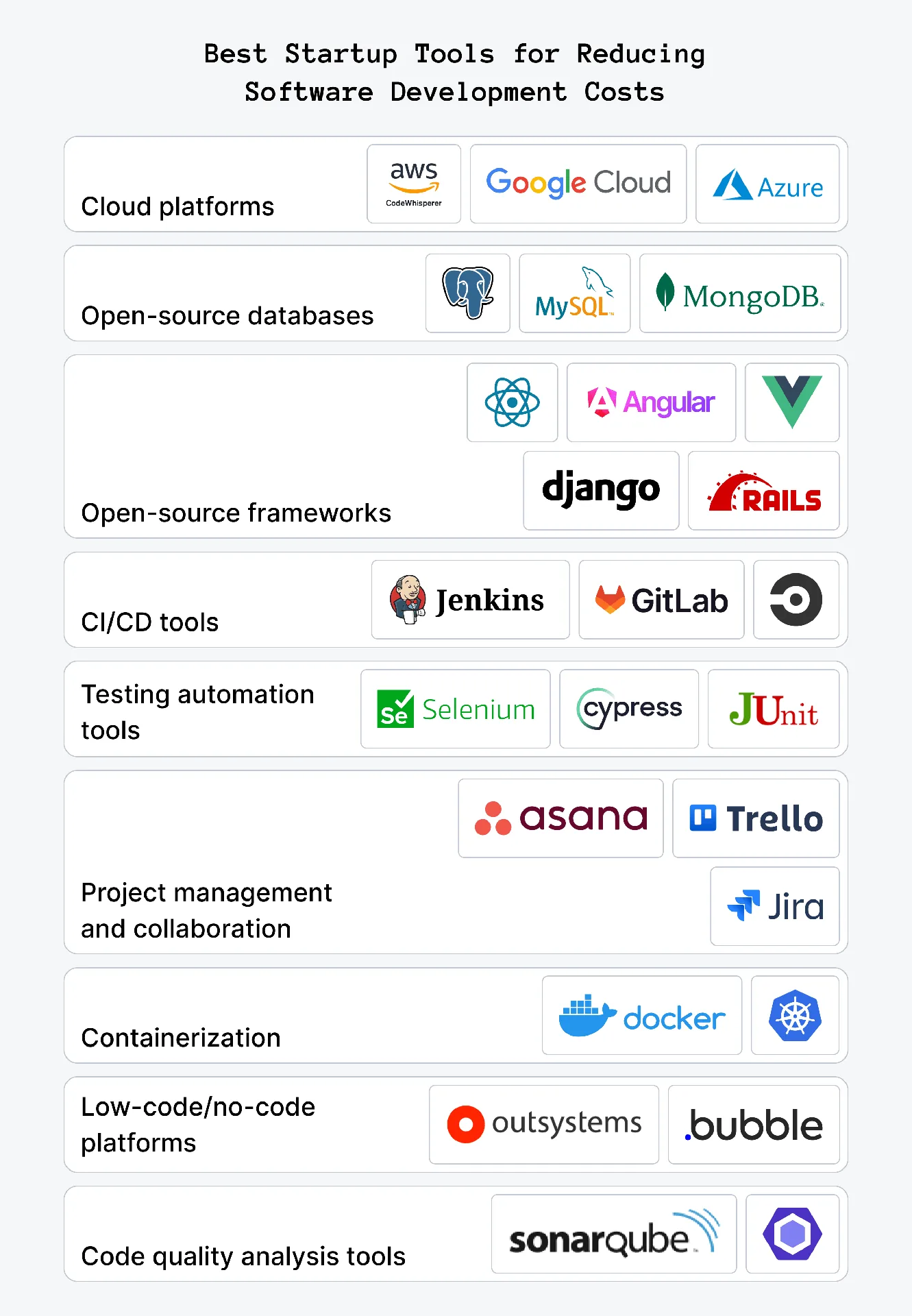 Source: Upsilonit.com
Pick Cost effective Technology
According to a detailed report by Full Scale, choosing a cost-effective technology stack is crucial because the wrong choice can cost companies an average of $2.3 million, with many projects exceeding budgets or getting canceled.
So, Your choice of technology stack plays a big role in both initial development costs and future expenses. For backend, popular options include Node.js, which is great for fast development and has a large developer community. PHP remains affordable with widespread hosting support. On the frontend, React is the most popular choice and easy to find developers for, Vue.js offers an easier learning curve, and Angular works well for complex apps.
When it comes to databases, PostgreSQL is a free and powerful option, MongoDB fits projects needing flexible data structures, and MySQL is simple and widely supported. Hosting solutions vary from AWS, which automatically scales and offers pay-as-you-use, to more affordable and straightforward options like DigitalOcean. For beginners or frontend apps, platforms like Heroku and Vercel provide easy deployment and optimized environments.
Take Advantage of Open Source
Open source software can save you thousands of dollars. Instead of building everything from scratch, use existing solutions.
According to Industry analysis, a typical startup might spend $50,000 annually on software licenses and by using open source alternatives, you could reduce this to under $10,000 while getting similar functionality.
Essential open source tools for startups include authentication services like Firebase Auth, payment processing that can start free with Stripe, and analytics platforms such as Google Analytics and Mixpanel’s free tier. For communication, open-source Slack alternatives like Mattermost offer cost-effective options.
Project management can be handled using GitLab or Trello alternatives. Developers benefit from free tools like Visual Studio Code for coding, Git and GitHub for version control (free for public repositories), Figma for design with a free tier for small teams, and testing tools like Jest and Cypress, both of which are free
Implement Smart Development Practices
Good development practices save money by preventing expensive mistakes and reducing maintenance costs.Work in short 2-week sprints. This helps you to catch problems early when they're cheap to fix and to adjust direction based on user feedback. It helps you to avoid building unnecessary features.

You must have team members review each other's code. This prevents bugs that would cost 10x more to fix later.Write tests for your code. While it takes extra time upfront, it saves massive debugging time later. Companies with good testing practices spend 50% less time fixing bugs.Then, Document your code and decisions. When new developers join your team, they'll get productive faster instead of spending weeks figuring out how things work.
Use Cloud Services Strategically
Cloud services can save money when used strategically, but they may become expensive if mismanaged. Start small by beginning with the smallest server size because most cloud providers allow instant upgrades as needed, a $20/month server can often handle thousands of users. Use auto-scaling to automatically add capacity during high traffic and reduce resources during slow periods, avoiding costs for unused capacity.
Also, monitor your cloud usage regularly to catch forgotten services or idle servers that still incur charges. Popular startup-friendly cloud offers include AWS Free Tier with 12 months of basic free services, Google Cloud’s $300 credit for new users, and Microsoft Azure’s $200 credit for new accounts, all designed to help startups get started cost-effectively.
You can also read Why Custom Mobile Apps Are Essential for Modern Business Success?
Focus on User Experience
Studies show that good UX can reduce customer support queries by 40% and boost user retention by 25%, lowering ongoing costs and increasing revenue from the same development investment.
Great user experience (UX) saves money by making products easier to use, leading to fewer support requests and more loyal users. Following simple design principles like keeping interfaces clean, using familiar patterns, testing with real users, and providing helpful error messages helps minimize confusion and frustration.
Plan for the Future
When focusing on low costs, it’s important not to overlook future growth needs. Building a scalable architecture means designing your software so it can grow smoothly with your business, by making smart choices in database design and code structure without overcomplicating things.
Avoid technical debt, which is like financial debt that adds up over time; shortcuts now may seem cheaper but often lead to higher costs down the road. I would say that encouraging a learning culture within your team helps them adopt new technologies and best practices, resulting in better, faster software development and cost savings in the long run.
Conclusion
Building great software on a startup budget is making smart choices that maximize impact while minimizing costs. Start with an MVP, choose the right team structure, leverage no-code tools where appropriate, and use open source solutions.Remember, some of today's biggest companies started with minimal budgets and smart development strategies. Facebook was built in a Harvard dorm room, and Airbnb's first version was created in just a few days using simple web tools.
The key is to focus on solving real problems for your users rather than building the most technically impressive solution. And in this journey Codesuite can help your startups launch faster by guiding MVP design, integrating scalable technologies, and providing no-code and open-source solutions that cut costs without sacrificing quality.
With skilled teams and user-focused practices, Codesuite makes software development services affordable and stress-free for growing businesses.Your success depends not on the budget, but on making smart, strategic choices,and Codesuite is there to help every step of the way.You can avail services