

How to Choose the Right Tech Stack for Your Next Mobile App (Flutter vs Native)?
Aug. 22, 2025
3225

Table of Contents
According to recent market analysis, by 2025, Flutter has become the top cross-platform mobile framework, favored by 46% of developers worldwide for speeding up development and reducing costs by 30–40% with a single codebase for multiple platforms.
Choosing a tech stack for your mobile app is like laying the foundation for your dream house. When you pick the right base, your app can grow smoothly and confidently. But if you choose the wrong tools, you might face costly and stressful fixes later.With nearly 7 billion smartphone users and over 6 million apps available across Google Play and the Apple App Store, smart tech choices are just as important as great design.
In this blog, we will discuss the factors that influence your tech stack decision, compare cross-platform frameworks like Flutter with native development, discuss the impact on cost and speed, and provide you with a clear framework.
What Exactly Is a Tech Stack?
A tech stack is like the DNA of your app, the collection of tools and technologies that determine how quickly you can develop your app, how well it can grow over time, and how easy it is to maintain.This includes
- The frontend frameworks, which control what users see and interact with, such as the design, animations, and navigation.
- Backend services like databases, authentication systems, APIs, and serverless functions that handle the app’s logic and data.
- Development tools such as IDEs, continuous integration and delivery (CI/CD), and testing tools to help your team build and maintain the app.
- Third-party integrations like payment systems, analytics, and notifications add features that support your app’s growth.
Why Flutter Is Taking the Lead?
Flutter has become the most popular cross-platform mobile framework globally, and this popularity shows the real success for development teams that want to launch on both iOS and Android without doubling their work.Let us have a look at the statistics of flutter vs React Native Search volume.
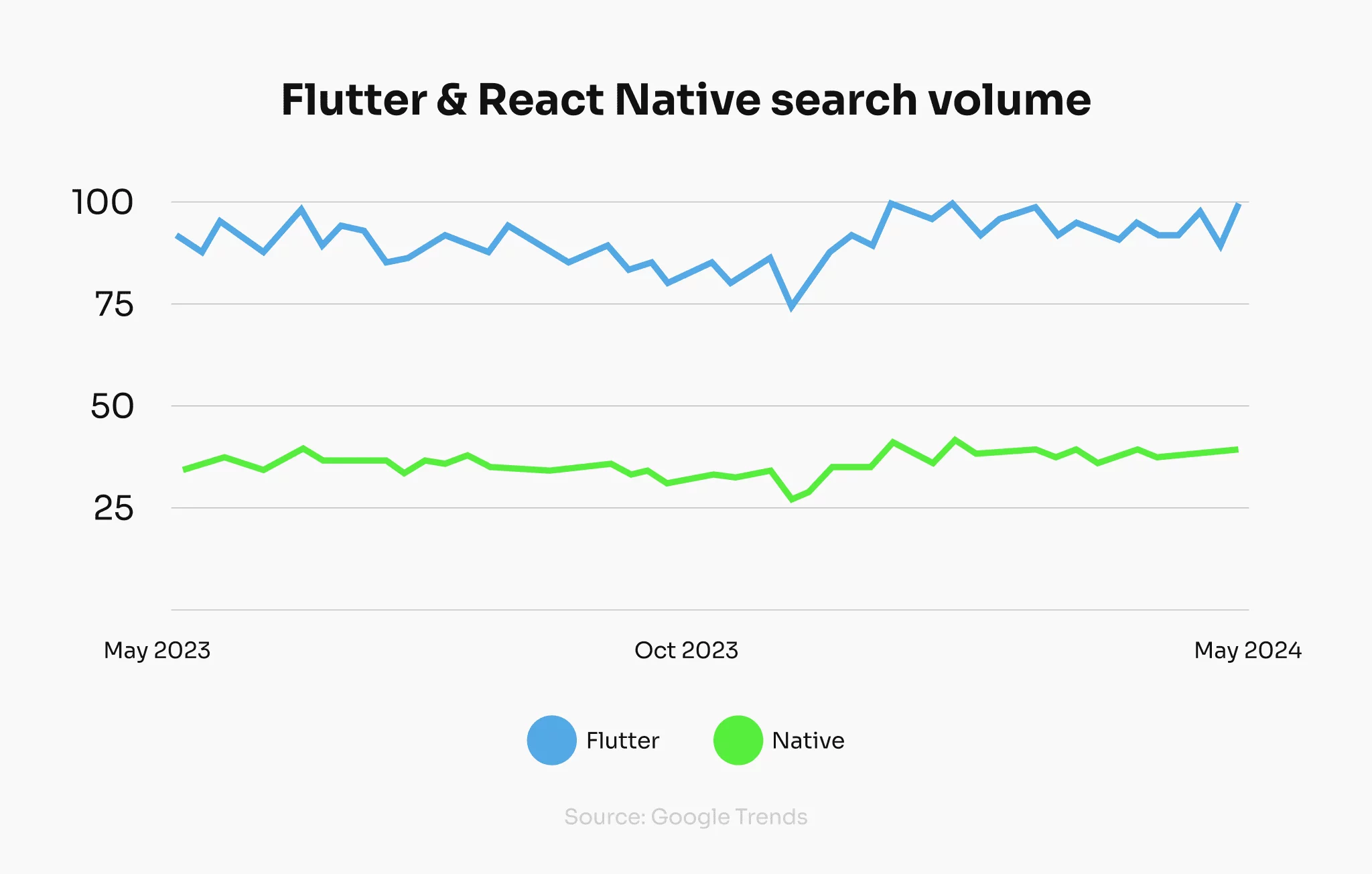
What sets Flutter apart is its single codebase that runs on two platforms. It reduces duplicated effort and ensures a consistent user experience across devices. Many major companies, like Alibaba, trust Flutter for their apps, proving its reliability for enterprise use. Flutter helps control costs through leaner teams and faster releases, cutting development expenses by around 30–40% compared to building separate native apps.
Four Factors That Should Drive Your Decision
1. Project Timeline & Budget
If you need to launch your app quickly and keep costs low, cross-platform tools like Flutter are a great choice. With Flutter, you can save 30–40% on development costs and finish the project up to 50% faster compared to building separate native apps for iOS and Android. This speed and affordability often help startups and small teams catch market opportunities before competitors.
2. Team Skills
The best tech stack is one your team can actually use well. If your developers have experience with Dart or cross-platform development, Flutter is a natural fit. If most of your team knows Swift or Kotlin, building natively might be smoother. Upskilling takes time, so be realistic about what your team can handle without needing major training.
3. App Complexity
Studies show native apps still edge out cross-platform alternatives for processing speed and high-end features. For apps that are mostly about content and forms, such as shopping or booking apps, cross-platform frameworks like Flutter can deliver a “native feel” with less work. However, if your app needs advanced features, like heavy graphics, AR, or direct access to device hardware, native development remains better for performance and reliability.
4. Future Proofing
Think about where your app will be in the next couple of years. If you plan to add new features, reach more platforms, or handle bigger user numbers, choose a tech ecosystem that is active and well-supported by its community. Flutter, for example, is updated regularly and has strong community backing. This makes it a safe bet for future growth and ongoing support.
Read about The Importance of UX/UI Design in Custom Software Development?
Popular Tech Stack Patterns for 2025
Here are some simple examples of tech stack patterns that teams are using this year:
Flutter Stack
For projects focusing on speed and ease of use, many developers choose Flutter for the frontend. This means you use just one codebase for both iOS and Android. Often, Firebase or Node.js is the backend, paired with databases like Firestore or PostgreSQL. This stack is great for rapid prototyping and keeping your app looking consistent across devices.

React Native Ecosystem
If your team is strong in JavaScript, React Native is a smart choice for the frontend. The backend is usually handled with Node.js and Express, with data stored in MongoDB or PostgreSQL. Tools like Redux help manage app state, while React Navigation handles screen transitions. This stack allows you to share a lot of logic with web apps, saving developer time.
Native Powerhouse
When you need the very best performance or advanced hardware features, building natively is the way to go. This means using Swift (with SwiftUI) for iOS and Kotlin (with Jetpack Compose) for Android. The backend can be any technology your team prefers, such as Node.js, Python, or Go, connected to a robust database like PostgreSQL. This stack is ideal for apps that demand top speed and platform-specific details.
Which Common Tech Stack Mistakes You Should Avoid?
A recent report shows that many app projects slow down or go over budget because teams don’t watch out for common warning signs in their tech stack choices. One major risk is chasing trendy tools just because they’re new. If a library isn’t well-documented, your project may hit serious roadblocks. It’s also important to recognize the time and effort needed to learn new technologies. Switching stacks during development can lead to big delays and extra costs unless you plan proper training.
Maintenance can be a hidden challenge too. Always check if your chosen tools are updated often and have clear roadmaps for future upgrades and security fixes. Integrations do matter, features like payments, notifications, and user authentication should work smoothly from day one. Make sure the tech you pick supports these functions reliably, so your app can grow without headaches down the road.
You can also read How to Digitize Your EdTech App Development Process with CodeSuite?
Why choose Codesuite for Your Mobile App?
When it comes to choosing the right tech stack for your next mobile app, whether Flutter or native, partnering with the right development team is essential. At CodeSuite, we specialize in mobile app development that’s according to your goals, budget, and timeline.
Our experts guide you through the tech stack decision process and deliver scalable, high-quality apps that provide an exceptional user experience on both iOS and Android. With proven expertise in Flutter and native development, we help you avoid costly mistakes and accelerate your path to market. Ready to bring your app idea to life? Discover our mobile app development services by Codesuite and contact us to get started on a custom solution that truly powers your success.
Conclusion
In 2025, choosing the right tech stack for your mobile app can make a big difference. If you want to build fast, save money, and deliver a smooth experience across devices, Flutter and other cross-platform tools are excellent choices. But if your app needs the best performance or must use specific platform features, native development might be better.
At Codesuite, we build mobile app solutions that scale, adapt, and deliver real impact. Let’s create an app that not only meets your requirements but also drives your business forward. Contact CodeSuite today, and let’s transform what your mobile app can achieve!