

Why U.S. Companies Should Prioritize AI Software Development for Competitive Advantage
Dec. 20, 2025
734

Table of Contents
Recent industry surveys show that more than 50% of organizations worldwide are already using some form of AI in their operations, and this share is rising every year. U.S. companies that invest in AI today can cut costs, move faster, and build products that are hard for competitors to copy. AI is not just a “nice‑to‑have” tool anymore; it is becoming a core part of how leading firms design software, serve customers, and make decisions.
In this blogpost, we will look into the importance of AI Software development for your business. Let us dig deeper into the details…
What is AI Software Development?
It means building software that uses artificial intelligence to learn from data, make decisions, or automate tasks that usually need human intelligence. This includes machine learning models, natural language processing (NLP), computer vision, and generative AI tools built into apps, platforms, and internal systems.
Instead of writing only fixed rules, teams design systems that can improve over time as they see more data. This makes software smarter, more flexible, and more valuable for both the company and its customers.
Why it matters now for U.S. companies?
Market pressure on U.S. companies is intense, and AI is quickly becoming a standard part of doing business.
- Over half of companies worldwide planned to add AI into their tech stack in 2024, showing how fast adoption is growing.
- In software engineering, 52% of organizations reported reduced software development costs in late 2024 after using generative AI.
- The global AI user base has grown from about 116 million to around 378 million in the past few years, an increase of more than 200%
For U.S. firms, this means: if you are not investing in Software Development, your competitors probably are. That gap will grow every year as their systems keep learning and improving, while yours stay the same.
Direct competitive benefits
It ties directly to competitive advantage by improving speed, cost, quality, and innovation.
1. Faster development and time‑to‑market
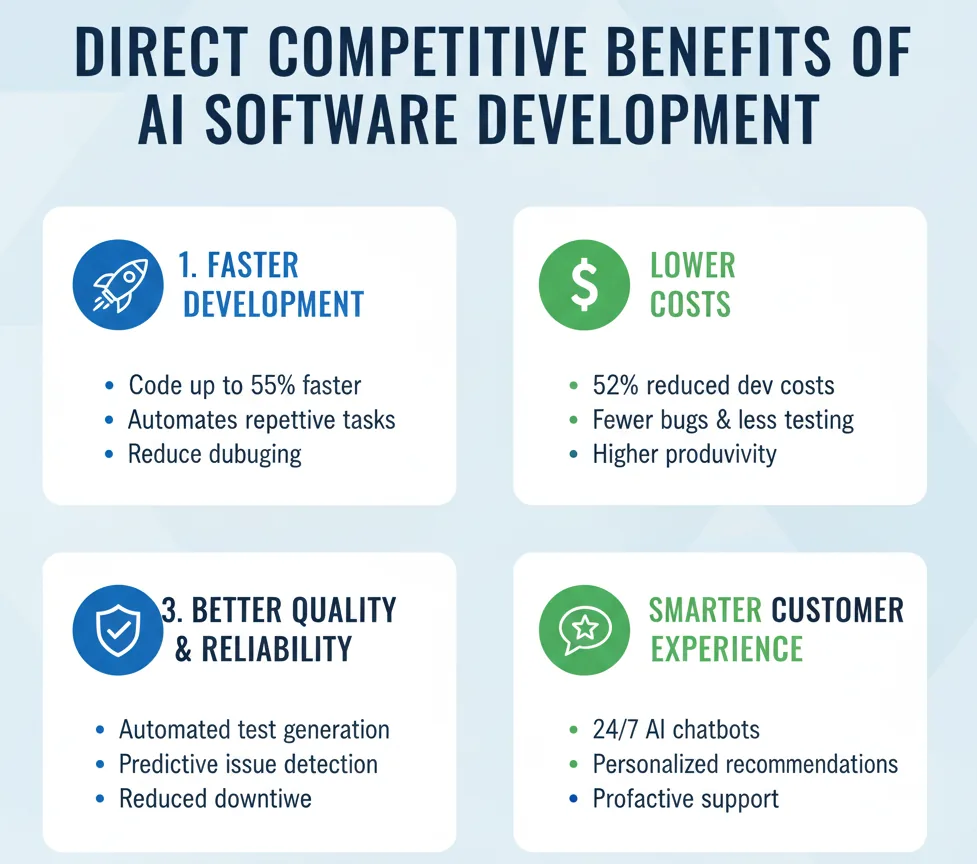
AI tools can speed up software delivery from idea to launch.
- AI coding assistants and automation tools can help developers code up to about 50–55% faster and reduce debugging time.
- AI can automate repetitive tasks like boilerplate code, code formatting, and basic debugging, freeing engineers to work on complex features.
- By using AI across the whole product lifecycle companies can release more versions, test more ideas, and adapt quickly to user feedback.
When a U.S. company can launch a feature weeks or months earlier than a rival, it wins customers quicker and sets the standard others must follow
2. Lower development and operational costs
It reduces costs in engineering and operations at the same time.
- McKinsey reports that 52% of organizations saw reduced software engineering costs after adopting generative AI, often translating into millions of dollars saved per year.
- Savings come from fewer hours per feature, fewer expensive production bugs, and less manual testing and routine DevOps work.
- In general, 56% of companies already use AI to improve and optimize operations, gaining benefits like reduced operational time and higher productivity.
These savings can be reinvested in new products, better talent, or market expansion, creating a loop where AI keeps funding further innovation.
3. Better product quality and reliability
AI improves the quality of software products and services.
- AI‑driven testing tools automatically generate test cases, detect bugs earlier, and reduce reliance on slow manual testing.
- AI‑based monitoring and predictive analytics can spot performance issues before users notice them, reducing downtime.
- With higher code quality now, companies avoid large maintenance costs later and build stronger trust with customers.
High‑quality, stable products are harder for competitors to beat, especially in regulated or mission‑critical industries like finance and healthcare.
4. Smarter decisions with real‑time data
It allows businesses to use their data more effectively.
- AI systems can analyze huge volumes of data in real time, something humans or traditional tools cannot do efficiently.
- This helps companies predict market trends, understand customer behavior, and identify risks or opportunities faster than competitors.
- AI‑powered forecasting supports better strategic decisions in pricing, inventory, product planning, and marketing.
When leadership has faster and more accurate insights, the whole organization moves more confidently and reacts quicker to change.
5. Stronger customer experience and personalization
Customer experience is a major battlefield, and AI Software Development is a powerful weapon here.
- AI chatbots and virtual agents can handle customer questions 24/7, improving response time and lowering support costs.
- Recommendation engines use AI to personalize offers, content, and product suggestions, raising engagement and sales.
- Predictive service can anticipate customer needs, such as when a user might churn or when equipment might fail, enabling proactive support.
Companies that deliver more personal, responsive experiences build loyalty, which is very difficult for late‑moving competitors to take away.
Long‑term strategic advantages
Beyond short‑term efficiency, AI Software Development becomes a long‑term strategic asset for U.S. companies.
Durable differentiation, not just quick wins
Basic tools are easy to copy, but deep AI capabilities are not.
- Simple automation can be duplicated, but a well‑designed AI system trained on unique company data becomes a competitive asset others cannot easily match.
- Over time, AI models learn from customer interactions, internal processes, and market outcomes, making the system smarter in ways that are specific to that company.
This makes AI‑powered software a durable advantage, not just a temporary improvement.
Innovation engine across industries
It is relevant to almost every sector in the U.S. economy.
- In finance, AI can support real‑time fraud detection, risk scoring, and algorithmic trading.
- In healthcare, AI‑driven diagnostic tools help detect diseases more accurately and earlier, improving care and cutting costs.
- In retail and e‑commerce, AI forecasts demand, optimizes inventory, and powers personalization engines that drive revenue.
Firms that weave AI into their software are better able to discover new business models and services before competitors reach them.
Culture of continuous improvement
Integrating AI into software shifts how teams work, not just what they build.
- Automation of routine tasks lets employees focus on creative and high‑value work, improving morale and innovation
- AI‑based feedback loops (from user data, performance metrics, and market signals) push teams towards continuous experimentation and improvement
Over time, this creates a culture where the organization learns faster than rivals, which is one of the strongest forms of competitive advantage
Final Thoughts
Waiting to invest in Software Development raises major strategic risks.
- As more than half of global companies plan AI adoption, the “early adopter” window is closing.
- AI tools are getting cheaper and easier to use, which means late adopters will fight against competitors who already have years of data and experience.
- Companies that start now can build internal skills, refine their data strategy, and choose the right platforms before the market becomes too crowded.
At CodeSuite, we are optimistic about the future and think that more and more firms will begin to use AI for software development to maintain the quality services. In simple terms: AI Software Development is quickly becoming part of the basic competitive toolkit, like having a website or using cloud computing. U.S. companies that treat it as optional risk falling behind in cost, speed, and innovation, while those that prioritize it can build strong, lasting advantages in their markets.