

Microsoft Azure vs. Google Cloud Platform: The Ultimate Cloud Platform Comparison
Oct. 2, 2025
4451

Table of Contents
Here's a question that keeps business leaders awake at night: which cloud platform should we trust with our company's digital future?
On one side, you have Microsoft Azure, the powerhouse that connects seamlessly with the Microsoft tools your team probably uses every day. On the other side, there's Google Cloud Platform (GCP) is built by the same company that handles 8.5 billion searches daily and serves billions of YouTube videos without breaking a sweat.
Both platforms are incredible. Both have passionate fans. And honestly? Both can transform your business. But here's what matters: which one fits your specific needs?
Let's look at the numbers. According to Synergy Research Group, Amazon's market share in the worldwide cloud infrastructure market was 30 percent in the second quarter of 2025, ahead of Microsoft's Azure platform at 20 percent and Google Cloud at 13 percent. But market share only tells part of the story. What really matters is which platform helps your business succeed.
Think of it this way: choosing a cloud platform is like picking a business partner. You want someone whose strengths match your needs, whose tools feel natural to your team, and whose vision aligns with where you're headed.
So let's dig in and find your perfect match.
What Makes Each Special?
Imagine having a technology partner that already understands your business because they've been serving enterprises for forty years. That's Azure's superpower.
Azure's 2024 cloud market share is 24% and it's growing year after year. Looking backward, Azure was in 2018 at $5B quarterly revenue and is now around $25B making it the most profitable business unit of Microsoft. There's a good reason for this growth. When you're running critical applications that absolutely cannot fail, Azure's enterprise-grade reliability gives you peace of mind.
What makes Azure really special is how naturally it fits into existing business environments. If your company already uses Windows Server, Active Directory, Office 365, or any Microsoft product, Azure feels less like adopting new technology and more like expanding what you already have. Everything just clicks together. Your employees use the same login credentials across all systems. Your IT team manages everything from one familiar console. It's integration done right.
Azure's global footprint is also impressive. With over 60 regions worldwide, you can deploy applications close to your customers whether they're in Singapore, São Paulo, or Stockholm. This matters more than you might think because every millisecond of delay can cost you customers.
Google Cloud Platform as Powerhouse of Innovation
Now let's talk about Google Cloud Platform. This is the infrastructure that powers Google Search, Gmail, Google Maps, and YouTube. Think about that for a second. YouTube serves over 1 billion hours of video every single day. Google processes over 8.5 billion searches daily. That's the kind of battle-tested, hyperscale infrastructure you're getting access to.
What makes GCP different is its DNA. While other cloud providers adapted to the cloud era, Google was born in it. They literally invented many of the technologies that define modern cloud computing. Google created them to solve their own massive-scale challenges, then shared them with the world.
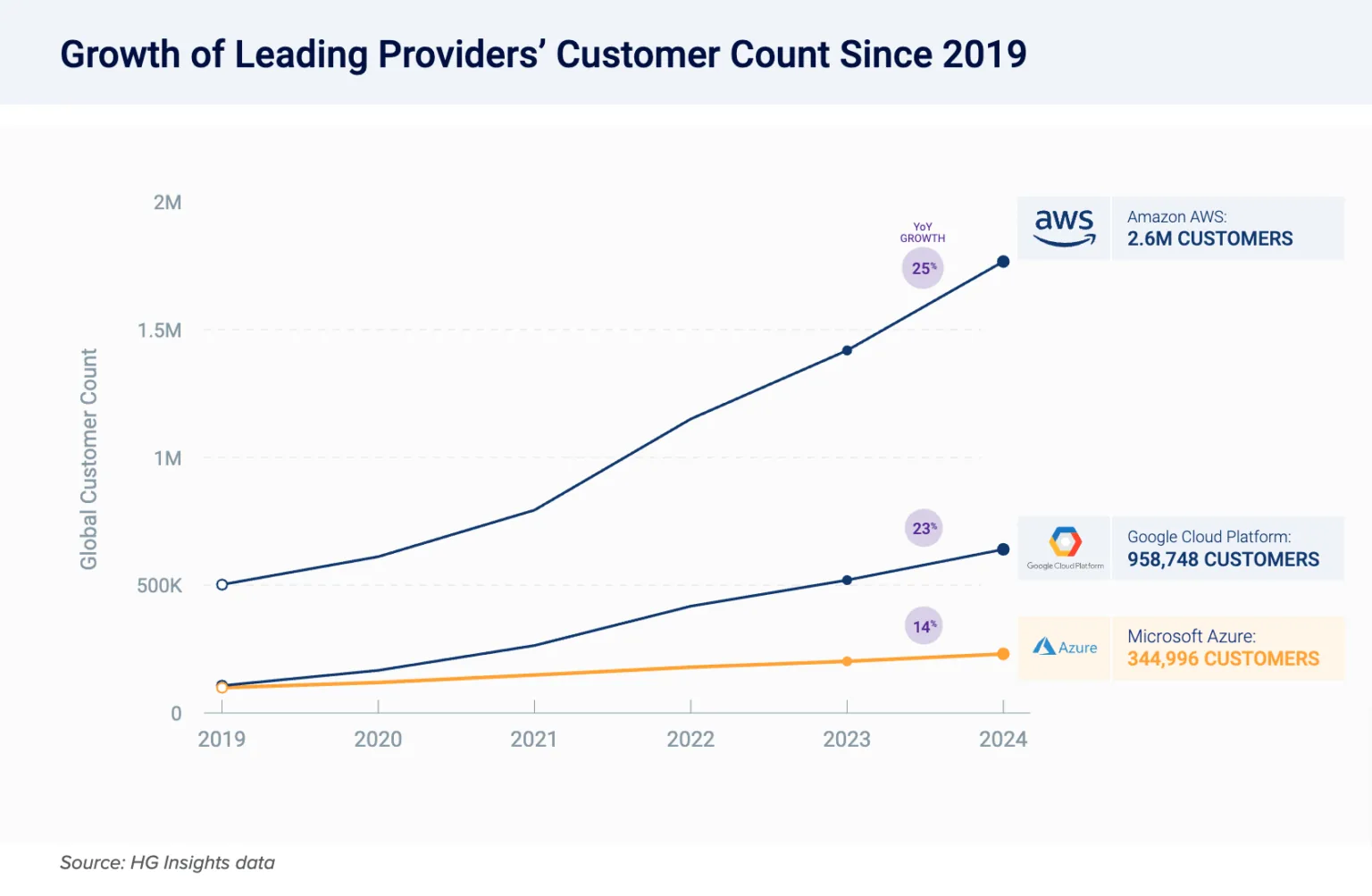
From 2023 to 2024, GCP's customer base grew by 23%, while AWS and Azure grew by 25% and 14%, respectively. Why are businesses flocking to GCP? Because it removes obstacles and lets developers build quickly. The platform is designed with a clean, intuitive interface that developers actually enjoy using. When your competitive advantage depends on shipping features faster than your rivals, every day saved matters.
Google's machine learning and artificial intelligence tools are also in a league of their own. This isn't just marketing hype. Google has been doing AI at scale longer than anyone else. Gmail's spam filtering, Google Photos' object recognition, Google Translate's accuracy, all powered by the same AI infrastructure you can now use in your applications.
Read more about the Why Custom Software Development Services Are Key to Business Scalability in 2025?
Where Azure Shines Brightest?
Let's get specific about where Microsoft Azure really excels.
Integration with the Microsoft Ecosystem
If your company runs on Microsoft technologies, Azure isn't just an option, it's the obvious choice. Migrating Windows Server applications, SQL Server databases, or .NET applications to Azure is remarkably smooth. We're talking about 40-60% less time and effort compared to other platforms. Why? Because Azure was built to support these technologies from the ground up, not as an afterthought.
Hybrid Cloud Leadership
No other platform handles hybrid cloud scenarios as elegantly as Azure. Azure Arc extends Azure's management capabilities to any infrastructure, your datacenter, other clouds, even edge locations. You get consistent tools, security policies, and governance everywhere. For organizations with complex regulatory requirements or significant on-premises investments, this flexibility is invaluable.
Support and Compliance
Azure holds over 90 compliance certifications, more than any other cloud provider. Need HIPAA for healthcare data? Check. PCI DSS for payment processing? FedRAMP for government work? The certification list goes on. Beyond certifications, Azure's enterprise support is mature and comprehensive. When something breaks at 3 AM, you want experts who can fix it fast. Azure delivers.
Active Directory Integration
For enterprises, Active Directory isn't just a tool—it's the foundation of their security infrastructure. Azure Active Directory extends your existing identity management to the cloud seamlessly. Single sign-on, multi-factor authentication, conditional access—it all works together beautifully. Employees access cloud applications with the same credentials they use for everything else. IT teams manage access from one central location.
This might seem obvious, but it's worth emphasizing. If you're running Windows-based applications, Azure is purpose-built for them. Performance is optimized, licensing makes sense, and compatibility is guaranteed. Other cloud providers can run Windows workloads, but Azure runs them better.
Where Google Cloud Platform Dominates
Now let's look at Google Cloud Platform's superpowers.
BigQuery isn't just another database, it's a game-changer. Imagine being able to analyze petabytes of data using simple SQL queries, getting results in seconds, and paying only for what you actually query. Traditional data warehouses require expensive hardware, specialized database administrators, and hours of query optimization. BigQuery eliminates all that complexity. Marketing teams can analyze customer behavior across millions of transactions. Product teams can mine user data to discover patterns. Finance teams can run complex forecasting models. All without waiting for IT to provision infrastructure.
Google has been doing artificial intelligence at massive scale for over a decade. Now they've made that expertise available to everyone through tools like Vertex AI and AutoML. You don't need a PhD in machine learning to build intelligent applications. The platform guides you through the process, from data preparation to model training to deployment. Companies that previously couldn't afford machine learning teams can now build sophisticated AI-powered features.
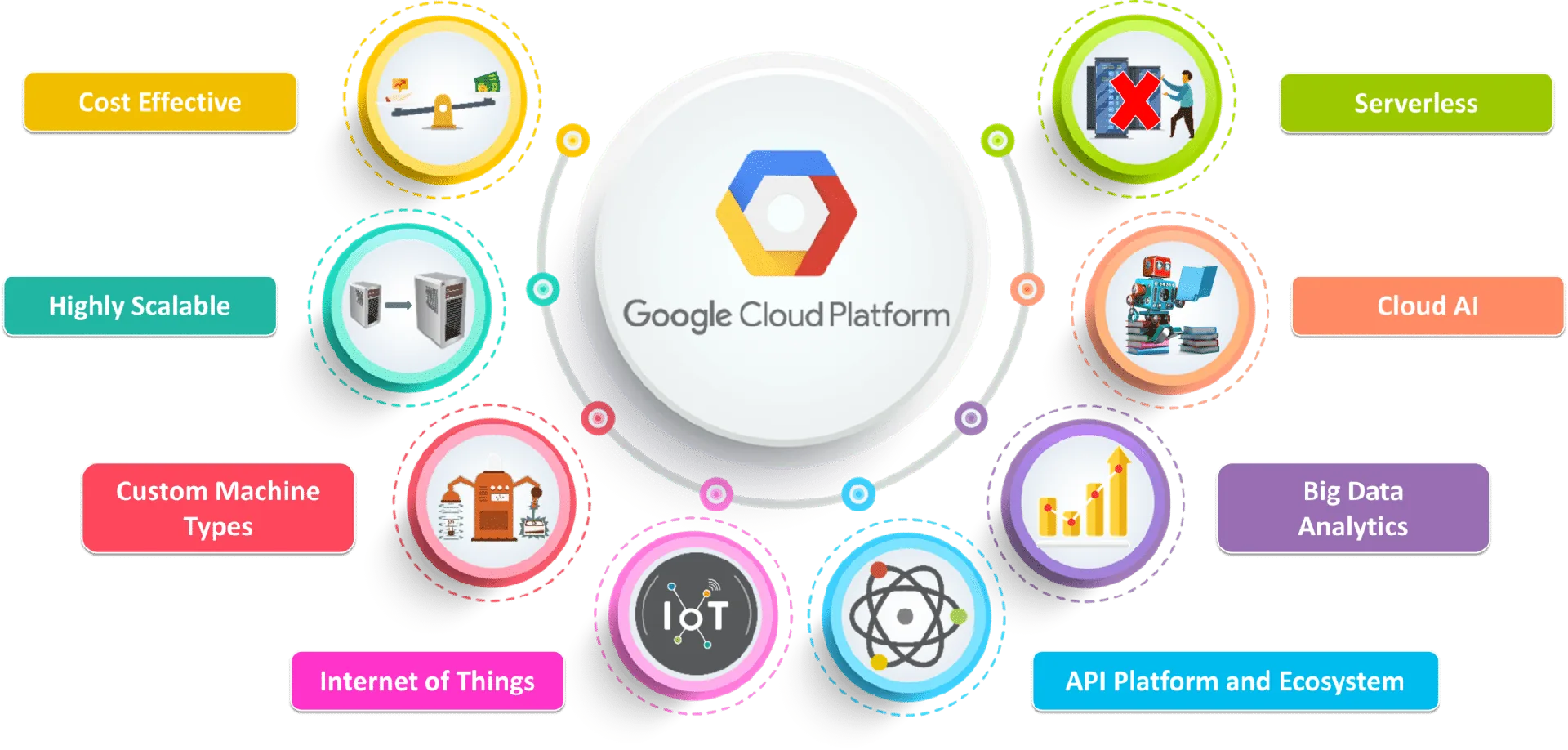 Image credit: edureka
Google pioneered sustained-use discounts, which automatically reduce your costs the more you use their services. No complex reservations to manage, no upfront commitments to calculate. Just automatic savings. They also bill per second instead of per minute, which sounds small but adds up to real money over time.
Google Cloud Platform embraces open-source technologies rather than forcing proprietary solutions. Want to run open-source databases like PostgreSQL or MySQL? GCP supports them natively. Prefer Apache Kafka for messaging? It works beautifully. This commitment to openness reduces vendor lock-in and gives you flexibility.
Choose Google Cloud Platform When...
Data analytics is central to your business. If competitive advantage comes from understanding and acting on data, BigQuery alone justifies choosing GCP. The platform's analytics capabilities are simply superior, making complex analysis accessible and affordable.
You're building AI-powered applications. Google's machine learning tools, infrastructure, and expertise are unmatched. If AI is core to your product strategy rather than a nice-to-have feature, GCP provides the best foundation.
You're running containerized applications. While both platforms support Kubernetes, GKE is the gold standard. If you're building cloud-native applications using containers and microservices, GCP offers the smoothest experience.
Developer experience matters to your velocity. If your competitive advantage depends on shipping features faster than rivals, GCP's clean design and intuitive interfaces help developers work more efficiently.
Cost optimization is a priority. GCP's automatic sustained-use discounts, per-second billing, and generally lower prices can result in 20-30% cost savings compared to Azure for similar workloads.
You prefer open-source technologies. GCP embraces open-source more fully than Azure, reducing vendor lock-in and giving you flexibility to move workloads if needed.
The Multi-Cloud Option
You're not limited to choosing just one platform. Many sophisticated organizations use both Azure and GCP strategically, leveraging each platform's strengths. They might run enterprise applications on Azure while using GCP for data analytics and machine learning.
This multi-cloud approach provides the best of both worlds. You avoid vendor lock-in entirely. You use best-in-class services from each provider. You have built-in disaster recovery if one cloud has problems.
However, multi-cloud also adds complexity. You're managing two platforms instead of one. Your team needs expertise in both. Data transfer between clouds can be expensive. Security and compliance become more complex with multiple environments.
Multi-cloud makes sense for large enterprises with sophisticated DevOps teams and complex requirements. For small to medium businesses, mastering one platform thoroughly usually provides better results than spreading resources across multiple platforms.
Conclusion
Both Microsoft Azure and Google Cloud Platform are strong choices for businesses looking to grow with cloud technology. Azure is often the best option for large enterprises, hybrid systems, and industries with strict security rules, while Google Cloud is great for advanced analytics, AI, and cost-friendly innovation.
No matter which platform you choose, Codesuite is here to support your cloud journey. With proven experience in building and delivering cloud-based projects, we help businesses move to the cloud, modernize their existing systems, and get the most out of tools like Azure and Google Cloud.
Our dedicated team has hands-on expertise in Azure and GCP services, making us a trusted partner for companies that want secure, scalable, and smart cloud solutions.
Get in touch with Codesuite today and let’s start building the right cloud future for your business.
FAQs
1. What is the main difference between Microsoft Azure and Google Cloud Platform?
Azure is known for its enterprise integration, hybrid cloud solutions, and strong support for Microsoft products, while Google Cloud excels in data analytics, AI, and open-source technologies.
2. Which is more affordable: Azure or Google Cloud?
Pricing depends on the services you use. Generally, Google Cloud is considered cost-effective for startups and data-heavy workloads, while Azure offers flexible pricing with discounts for enterprises already using Microsoft tools.
3. Which platform offers better AI and machine learning capabilities?
Google Cloud is often preferred for AI and ML due to its TensorFlow integration, BigQuery, and advanced AI tools. Azure also provides powerful AI services but is stronger in enterprise-ready integrations.
4. Is Microsoft Azure more secure than Google Cloud?
Both platforms are highly secure and compliant with global standards. Azure has an edge in compliance certifications, making it suitable for industries with strict regulations, while Google Cloud emphasizes advanced encryption and zero-trust security.
5. Which cloud platform is better for startups?
Google Cloud is popular among startups due to its credits, AI capabilities, and simple pricing. However, Azure is a strong choice for businesses planning long-term enterprise scalability and hybrid solutions.