
LMS vs. Custom Platform: Which EdTech Solution is Right for Your Business?
Dec. 5, 2025
786

Table of Contents
LMS vs. custom platform is not just a tech question; it is a business decision that affects cost, growth, and learner success. To choose the right EdTech solution, you need to look at your goals, budget, timeline, and how important learning is to your competitive edge.
Why This Choice Matters?
The global LMS market is worth around 27 billion dollars in 2025 and is expected to grow to more than 80 billion dollars by 2032, with a growth rate above 17% per year. At the same time, more companies are moving toward personalized and AI-driven learning, which pushes many of them to consider custom platforms instead of only off‑the‑shelf systems.
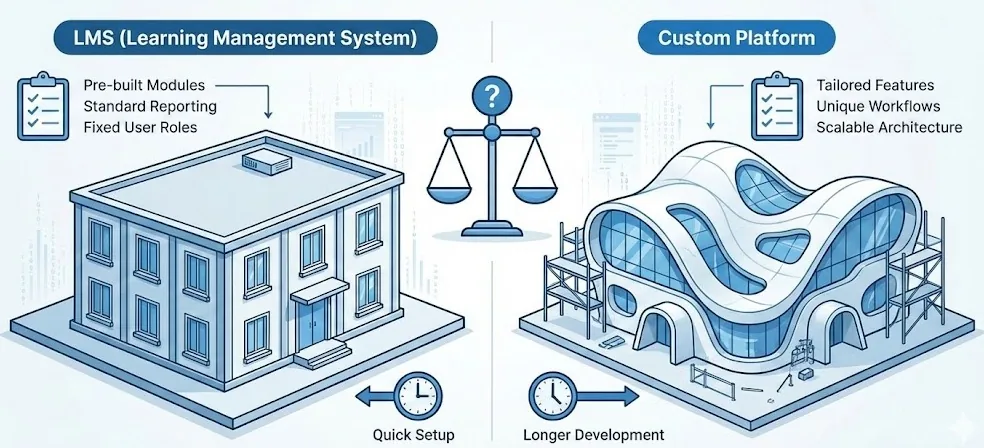
Many businesses work with an e-learning software development company to design the right mix of standard tools and custom features. Picking the wrong direction can lead to low adoption, high hidden costs, and platforms that need to be replaced in just a few years.
What Is an LMS?
A Learning Management System (LMS) is a ready-made platform used to manage courses, users, assessments, and reports in one place. You usually pay per user or per month and get standard features such as course catalogs, quizzes, certificates, and progress tracking.
LMS platforms are becoming smarter: by 2025, around 80% of corporate LMS products are expected to use AI for personalization and optimization of learning paths. This means that even standard systems can now recommend content, adjust difficulty, and show detailed analytics without custom coding.
What Is a Custom Platform?
A custom platform is a solution that is designed and built specifically for your organization. Instead of adapting your processes to a ready-made LMS, the system is shaped around your workflows, branding, data, and technical ecosystem.
For many businesses where learning is part of the core product or a major revenue stream, a custom platform becomes a strategic asset rather than just a tool. In these cases, they often partner with an e-learning software development company to create proprietary user experiences, data flows, and AI models.
Key Differences at a Glance
|
Factor |
LMS (Off‑the‑Shelf) |
Custom Platform |
|
Cost (short term) |
Lower upfront; subscription or per‑user fees |
Higher upfront design and development cost |
|
Cost (long term) |
Can get expensive as users and add‑ons grow |
Often cheaper at scale; no per‑user vendor fees |
|
Time to launch |
Weeks to a few months |
Several months or more |
|
Customization |
Limited to vendor options and plugins |
Very high; built around your exact needs |
|
Integrations |
Prebuilt connectors; deeper links can be hard |
Tight integration with existing systems and data |
|
Ownership |
Vendor controls roadmap and features |
You own code, data model, and roadmap |
|
Innovation speed |
Depends on vendor release cycle |
Depends on your team or e-learning software development company |
LMS: Strengths and Weaknesses
Strengths of an LMS
An LMS is often the fastest way to start online training. Many platforms offer templates, drag‑and‑drop editors, and ready integrations with video tools and HR systems.
LMS platforms are proven to improve learning outcomes: some reports show that digital learning can boost retention rates up to about 60%, compared with less than 10% for traditional classroom methods. This makes them attractive for companies just starting their digital learning journey.
Weaknesses of an LMS
Standard LMS tools are not always flexible enough. Many organizations eventually discover that their LMS cannot handle unique workflows, complex simulations, or detailed product training. As a result, some companies look to replace their LMS or add complex plugins within just a few years.
Scaling can also increase costs. Per‑user pricing looks cheap at first, but once you reach thousands of learners, the total subscription bill can exceed what it would cost to own a custom solution. This is especially important for fast‑growing training businesses or large enterprises with many users.
Custom Platform: Strengths and Weaknesses
Strengths of a Custom Platform
Custom platforms turn learning into a competitive advantage. You can build Netflix‑style content discovery, gamified journeys, or deep simulations that reflect real work scenarios. This kind of tailored experience is difficult to achieve with a generic LMS.
Custom systems also integrate more deeply with your data. For example, you can track product usage, support tickets, or sales performance and connect them directly to learning activities, which helps measure ROI more accurately. With AI and analytics, some companies report double‑digit improvements in completion rates and strong gains in onboarding speed.
Weaknesses of a Custom Platform
The downside is investment. Building a serious custom platform requires significant time and budget, as well as product management and technical skills. If your organization is not ready to maintain software, updates, and security, you may struggle to keep the platform modern and stable.
This is why many businesses choose to work closely with an experienced e-learning software development company rather than trying to build everything only with an internal team. The right partner can reduce risk and help you avoid architectural mistakes that are expensive to fix later
Important Market and Usage Statistics
Several statistics can help guide this decision:
- The LMS sector is valued at about 27 billion dollars in 2025 and is projected to grow to roughly 82 billion dollars by 2032, with a growth rate of around 17% per year.
- Corporate demand is strong: more than two‑thirds of employees say that training and development are among the most important parts of company policy.
- AI is becoming standard: by 2025, about 80% of corporate LMS platforms are expected to include AI for personalization and optimization.
- LMS‑based training can significantly improve retention rates compared with traditional methods, showing up to 60% retention in some studies.
These numbers show that digital learning is not a niche area but a major long‑term investment.
When an LMS Is the Right Choice?
An LMS is usually the better option when your needs are straightforward and you want speed. For example, it works well for:
- Small and medium businesses that need compliance training, onboarding, or basic skills development.
- Organizations that want predictable monthly costs and do not yet have thousands of learners.
- Teams without deep technical expertise who rely on vendor support and updates.
In these situations, partnering with an e-learning software development company may still help you select, configure, and integrate the LMS correctly, without the cost of fully custom development.
When a Custom Platform Makes More Sense?
A custom platform is often the smarter choice in more advanced cases. Consider going custom if:
- Learning is part of your core product or business model, such as a training marketplace or EdTech startup.
- You need unique workflows, multi‑tenant portals, or heavy branding control across multiple clients.
- You want to connect learning tightly with other systems, such as CRMs, IoT devices, or custom internal tools.
- You expect to scale to tens of thousands of learners and want to avoid per‑user licensing costs.
In this context, an e-learning software development company can help you design the architecture, pick the right tech stack, and build an MVP that you can scale over time.
Hybrid and Composable Approaches
There is also a middle path. Many modern organizations are adopting a hybrid or “composable” stack, where they use an LMS for core learning functions but connect it with other systems via APIs. For instance, they might keep their website and marketing content in a CMS while using an LMS for assessments and reporting.
This approach lets you start with a standard LMS and gradually add custom micro‑services or front‑ends as you grow. In many cases, an e-learning software development company can help design this architecture so that you can switch pieces in and out without rebuilding everything.
Read more about the E-Learning Software Development: Complete Guide
Final Thoughts
To choose between LMS and custom platform, ask the following questions:
- How unique are your training workflows compared with typical corporate training?
- How many learners do you expect over the next three to five years?
- Do you need deep integrations with your product, data, or external partners?
- How much control do you want over the user experience and roadmap?
- What is your realistic budget and timeline for launch and for ongoing maintenance?
If most of your answers point toward speed, simplicity, and budget control, start with an LMS and optimize it. If most answers point toward uniqueness, scale, and long‑term ownership, a custom or hybrid solution will likely bring more value.
In many cases, the best approach is to start with a well‑chosen LMS and, with the help of an experienced e-learning software development company, move step by step toward more custom components as your needs grow.
CodeSuite can help you create the necessary e-learning software. Our expertise in software development and can assist companies with challenging aspects of their projects. Contact us if you need professional guidance on creating innovative e-learning software.