

How AI is Transforming Custom Fintech Software in 2026
Jan. 11, 2026
775

Table of Contents
- Key Takeaways
- What Makes Fintech AI Different in 2026?
- How Does AI Transform Core Fintech Operations?
- Which AI Technologies Power Custom Fintech Software?
- Why Do Regulations Matter for Fintech AI Development?
- What Should You Look for in Fintech AI Development Services?
- How Can Your Business Start with AI Implementation?
- What Challenges Should You Anticipate?
- How Is AI Reshaping Fintech Competitiveness?
- Final Thoughts
- Frequently Asked Questions
In 2026, agentic AI represents intelligent systems that not only interpret data but make decisions, trigger actions, and handle entire workflows without a human in the loop. Custom fintech software powered by AI is reshaping everything from fraud detection to customer engagement. Traditional banking systems that once took days to process loans now complete approvals in minutes.
In this article, we'll see how fintech AI development services are revolutionizing the financial sector in 2026.Let us dig deeper into why choosing the right development partner matters more than ever.
Key Takeaways
|
Aspect |
Impact in 2026 |
|
Market Growth |
AI in fintech projected to reach $41.16 billion by 2030 with 16.5% CAGR |
|
Enterprise Adoption |
75% of financial firms already utilize AI technologies |
|
Processing Speed |
Loan approvals reduced from 48 hours to 8 minutes using AI-powered underwriting |
|
Primary Applications |
Fraud detection, risk management, personalized banking, and regulatory compliance |
|
Technology Shift |
Moving from AI pilots to enterprise-wide agentic AI implementations |
|
Key Challenge |
Balancing innovation with regulatory compliance and data security |
What Makes Fintech AI Different in 2026?
Let's see in detail how AI has evolved beyond basic automation.
According to Grand View Research, the global artificial intelligence in fintech market size was valued at USD 9.45 billion in 2021 and is projected to reach USD 41.16 billion by 2030, growing at a compound annual growth rate (CAGR) of 16.5% from 2022 to 2030.
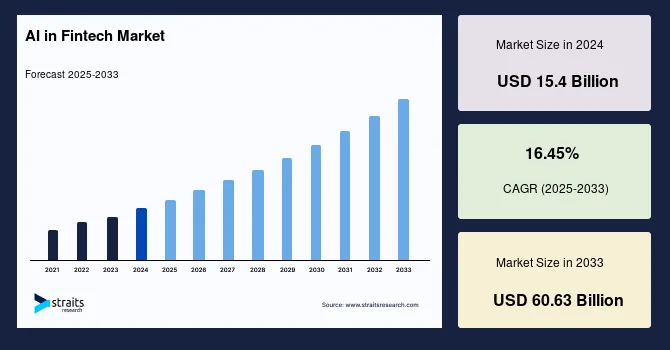
This represents a fundamental shift from reactive systems to proactive financial intelligence.Machine learning algorithms now power everything from credit scoring to investment strategies.
Natural language processing has transformed customer interactions. Modern AI assistants understand context, sentiment, and complex financial queries. Predictive analytics enables financial institutions to anticipate customer needs, market shifts, and risk factors.
How Does AI Transform Core Fintech Operations?
Fraud detection
According to Grand View Research's AI in Fintech Report, AI-powered fraud detection systems examine user behavior, transaction history, device information, and contextual data simultaneously.
AI capabilities are expanding in financial services, particularly in fraud detection and risk management. Traditional rule-based systems flag suspicious transactions based on predetermined patterns, but sophisticated fraudsters constantly evolve their tactics. AI systems analyze millions of transactions in real-time, identifying anomalies that signal fraudulent activity even when the patterns are completely new.
Customer Experience Enhancement
AI enables genuinely personalized financial experiences, predicting customer needs before they arise through advanced algorithms that analyze spending patterns and life events.
For you, this means AI-powered chatbots provide instant support, answering complex queries at any time without wait times.Intelligent financial software development creates interfaces that adapt to user preferences. The system learns how you prefer to interact with your finances and adjusts accordingly, making every touchpoint more intuitive and efficient.
Risk Management
AI-powered underwriting reduced loan approval time from 48 hours to 8 minutes, according to WEZOM's fintech development report.
Let's see in detail how AI transforms risk assessment. Traditional credit scoring relied heavily on credit history, often excluding millions of people with limited financial records. AI systems evaluate alternative data sources, rent payments, utility bills, education, employment history to create more comprehensive risk profiles.
Which AI Technologies Power Custom Fintech Software?
Deep learning and neural networks excel at pattern recognition in custom fintech application development, analyzing transaction data to identify fraud indicators and optimize trading strategies. Robotic Process Automation (RPA) handles repetitive tasks including data entry, account reconciliation, and compliance reporting, while intelligent automation services combined with AI create systems that make judgment calls and escalate only complex issues to human staff.
Combining blockchain with artificial intelligence creates powerful solutions for secure financial software modernization, where AI analyzes blockchain transactions for suspicious patterns, optimizes smart contract execution, and verifies identity across decentralized networks, enhancing both transparency and security.
Why Do Regulations Matter for Fintech AI Development?
The regulatory landscape in 2026 is probably the most complex it's ever been, with the EU AI Act rolling out obligations through 2027. For you developing custom fintech software, this means compliance can't be an afterthought, it must be built into your architecture from day one.
The Digital Operational Resilience Act (DORA) strengthens IT risk management across financial services. Even if your company isn't based in the EU, working with EU financial institutions could bring you under DORA's scope. This requires robust disaster recovery, incident response protocols, and continuous monitoring, all areas where AI can help maintain compliance automatically.
Read about The Patient-Centric Approach to Successful Healthcare Digital Transformation
What Should You Look for in Fintech AI Development Services?
Generic AI developers might build impressive technology, but fintech software development requires understanding regulatory requirements, security standards, and industry-specific use cases. Look for partners who demonstrate knowledge of financial regulations, payment processing, and banking operations.
Your development partner should prioritize security at every level. This includes data encryption, secure API development, regular security audits, and compliance with standards like PCI-DSS, GDPR, and regional financial regulations. Ask for case studies showing how they've implemented security in previous projects.
The best fintech AI development services handle everything from initial consultation and strategy through development, testing, deployment, and ongoing support. This integrated approach ensures consistency, reduces miscommunication, and provides you with a single point of accountability.
How Can Your Business Start with AI Implementation?
Starting your AI implementation doesn't require transforming everything at once. Identify specific pain points where AI delivers measurable value, fraud detection, customer service automation, or loan processing. These initial projects build momentum and demonstrate ROI. AI systems are only as good as the data they process, so ensure you have clean, organized data through legacy system modernization with proper data pipelines and governance policies.
Attempting to build custom AI solutions without expertise leads to costly mistakes and security vulnerabilities.The best fintech AI development services handle everything from consultation and strategy through development, testing, deployment, and ongoing support, ensuring consistency and providing a single point of accountability throughout your AI transformation journey.
You can also read The Future of EdTech: Personalized Learning and AI in E‑Learning Development
What Challenges Should You Anticipate?
Financial data is among the most sensitive information organizations handle. Implementing AI requires balancing data access for training models against strict privacy requirements. Solutions include federated learning, differential privacy, and on-premise deployment options for particularly sensitive applications.
Organizations are shifting from treating AI hallucinations as crises to managing them, acknowledging the inherent limitations of the technology. Addressing this requires diverse training datasets, regular bias audits, and human oversight for critical decisions.
How Is AI Reshaping Fintech Competitiveness?
The 2026 trend shows a shift from AI pilots to enterprise-wide programmes, with successful firms adopting modular AI architectures and governance controls. Companies that treated AI as an experimental technology are being overtaken by those embedding it throughout their operations.
According to Microsoft's Industry Blog on AI transformation, Frontier Firms that fully integrate AI report returns on investment roughly three times higher than slow adopters. This competitive gap will only widen as AI capabilities advance and customer expectations rise.
Speed to market matters more than ever. Financial institutions that deploy AI-powered features quickly gain advantages in customer acquisition and retention. This requires agile development practices, continuous deployment capabilities, and development partners who understand fintech's rapid pace.
Final Thoughts
AI is fundamentally transforming custom fintech software from simple automation tools into intelligent systems that drive business strategy, enhance customer experiences, and manage complex regulatory requirements. The institutions that succeed in 2026 and beyond will be those that embrace AI strategically, partner with experienced developers, and maintain focus on security and compliance.
At CodeSuite, we combine deep fintech expertise with cutting-edge AI capabilities to deliver solutions that drive real business results. Our team understands the unique challenges financial institutions face and creates custom software that balances innovation with regulatory compliance.
Reach out to us for best fintech AI development services that transform your operations, enhance security, and position your business for long-term success in an AI-driven financial landscape.
Frequently Asked Questions
What is fintech AI development?
Fintech AI development involves creating intelligent financial software using artificial intelligence technologies like machine learning, natural language processing, and predictive analytics to automate processes, enhance security, and personalize customer experiences.
How much does custom fintech AI software cost?
Costs vary widely based on complexity, features, and integration requirements, typically ranging from $50,000 for basic implementations to $500,000+ for enterprise-wide systems with advanced AI capabilities.
How long does it take to develop AI-powered fintech software?
Development timelines range from 3-6 months for focused applications to 12-18 months for comprehensive enterprise platforms, depending on scope, complexity, and regulatory requirements.
Is AI in fintech secure?
When implemented properly by experienced developers, AI enhances fintech security through real-time fraud detection, behavioral analysis, and anomaly detection. Security depends on proper architecture, encryption, and compliance with industry standards.
Can small fintech companies afford AI development?
Yes, cloud-based AI services and modular development approaches make AI accessible to companies of all sizes. Starting with focused use cases and scaling gradually makes implementation affordable and manageable.