

From Vision to Deployment: CodeSuite’s Framework for AI Product Strategy
Dec. 16, 2025
659

Table of Contents
A strong AI Product Strategy helps organizations move beyond experiments and pilot projects. It ensures that AI solutions are aligned with real business needs, supported by the right data, and built for long-term growth. CodeSuite addresses this challenge with a structured framework that guides businesses from the initial idea all the way to full deployment.
The Growing Importance of AI Product Strategy
In recent years, organizations across industries have invested heavily in AI technologies. Many have seen improvements in productivity and cost efficiency. However, research consistently shows that a large percentage of AI projects never reach production or fail to achieve expected results. This gap between potential and performance highlights the importance of strategy over technology.
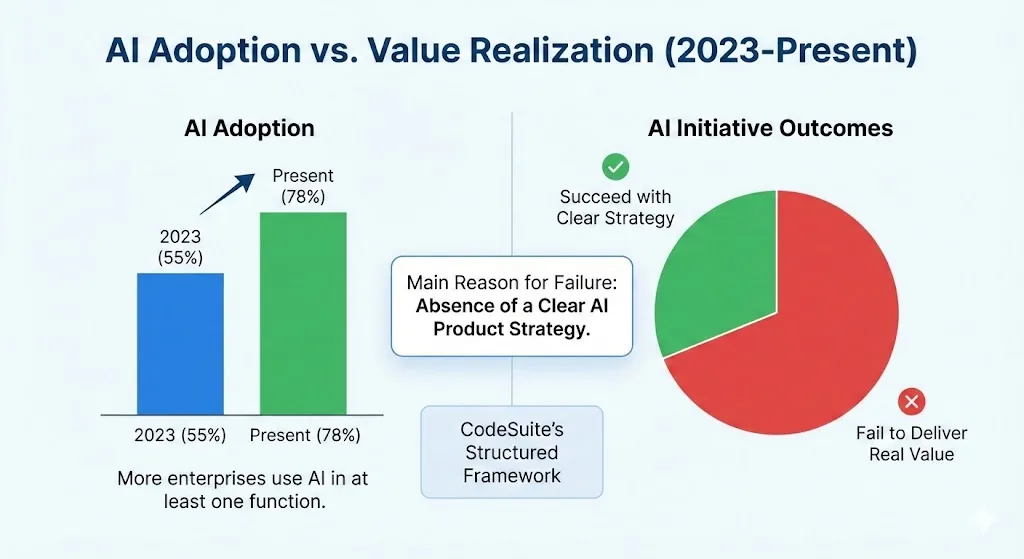
An effective AI Product Strategy provides clarity. It helps businesses understand why they need AI, what problem it should solve, and how success will be measured. Without this clarity, AI becomes an expensive experiment rather than a valuable business asset. CodeSuite’s approach focuses on reducing this risk by introducing a step-by-step framework that keeps both business and technical teams aligned.
Deciding If AI Is the Right Fit
The first step in CodeSuite’s framework is strategic alignment. This phase focuses on answering a critical question: is AI truly the right solution for the problem at hand? Many organizations assume that AI is always the best choice, but this is not always true.
In this phase, businesses evaluate whether they have access to sufficient and reliable data and whether the problem is complex enough to require machine learning. They also consider scalability, accuracy expectations, and legal or ethical constraints. Strategic alignment prevents organizations from investing in AI where simpler solutions would work just as well. When AI is chosen for the right reasons, the chances of long-term success increase significantly.
Vision and Product Strategy
Once AI is confirmed as a suitable approach, the next step is defining a clear vision and product strategy. This phase focuses on creating a shared understanding of what the AI product aims to achieve and who it is designed for. A strong vision acts as a guiding light for the entire team and helps maintain focus throughout the development process.
CodeSuite emphasizes that AI products should be built around real user needs rather than technical possibilities. The product strategy defines the target audience, the problem being solved, and the outcomes the business wants to achieve. Agile and lean principles are used to keep the strategy flexible, allowing teams to learn and adapt as new insights emerge. This approach ensures that the product remains relevant and valuable as it evolves.
Discovery Phase
The discovery phase is where ideas are explored in depth. During this stage, teams focus on understanding users, market trends, and competitive solutions. The goal is to identify AI use cases that are both valuable and achievable.
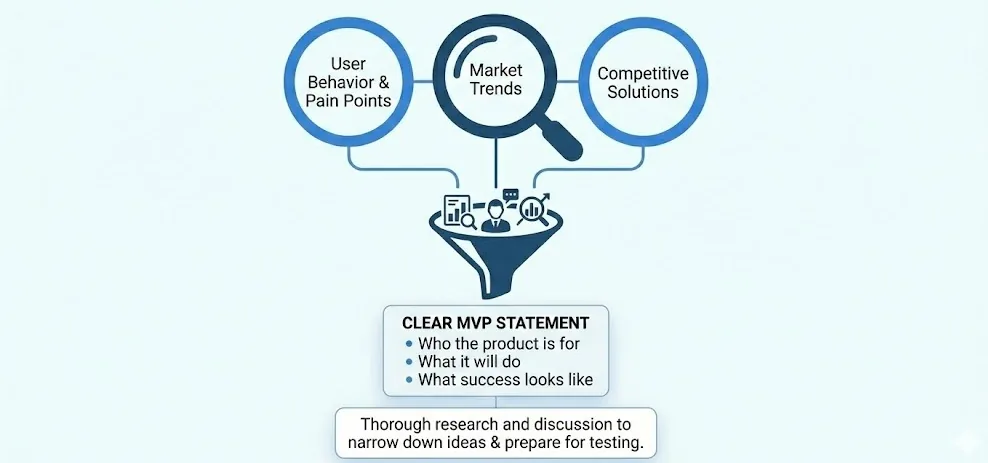
Rather than rushing into development, CodeSuite encourages thorough research and discussion. This includes studying user behavior, identifying pain points, and analyzing how AI can create meaningful improvements. Based on these insights, teams create clear MVP statements that describe who the product is for, what it will do, and what success will look like. This structured thinking helps narrow down ideas and prepares them for testing.
Validation Through Minimum Viable Testing
Validation is one of the most important phases in CodeSuite’s AI Product Strategy framework. Instead of building a full-scale product, teams test their ideas through Minimum Viable Testing. This means creating simple prototypes or experiments that can quickly show whether an idea works in the real world.
During this phase, user feedback and performance data play a central role. Teams observe how users interact with the prototype and measure results against predefined goals. If the results are positive, the idea moves forward. If not, it is refined or abandoned. This process reduces risk, saves resources, and ensures that only the most promising ideas move into full development.
Scaling and Deployment
Once an AI solution has been validated, it is ready for scaling and deployment. This phase focuses on transforming a successful prototype into a reliable, production-ready product. It involves improving performance, expanding features, and building strong infrastructure to support growth.
CodeSuite also emphasizes the importance of teamwork during this stage. Successful deployment requires close collaboration between product managers, engineers, designers, and data specialists. Proper monitoring systems are put in place to track performance, ensure accuracy, and maintain data quality. When done correctly, scaling allows businesses to fully integrate AI into their operations and achieve long-term value.
Why CodeSuite’s Framework Delivers Results
CodeSuite’s framework works because it balances innovation with discipline. Each phase is designed to answer specific questions and reduce uncertainty. By focusing on strategy before technology, the framework helps organizations avoid common mistakes such as building AI products without clear goals or ignoring user needs.
Another strength of this approach is its emphasis on continuous learning. Feedback is collected at every stage, allowing teams to adapt quickly. This makes the framework suitable for businesses of all sizes, from startups experimenting with AI to enterprises scaling complex solutions.
Key Lessons for Building Successful AI Products
Experience across industries shows that AI success depends less on advanced algorithms and more on thoughtful planning. Companies that treat AI as a strategic initiative rather than a technical upgrade are far more likely to see meaningful results. Aligning AI efforts with business objectives, involving cross-functional teams, and measuring outcomes consistently are critical practices.
Final Thoughts
AI has the power to transform businesses, but only when it is guided by a clear strategy. CodeSuite’s five-phase framework provides a practical roadmap for turning AI ideas into successful products. By focusing on alignment, vision, discovery, validation, and scaling, organizations can avoid common pitfalls and build AI solutions that truly matter.
With the right AI Product Strategy in place, businesses can move beyond experimentation and unlock sustainable growth. CodeSuite’s approach proves that when strategy leads the way, AI becomes not just a technology, but a powerful driver of real-world results.