

Delivering on Time and Budget: Best Practices for Fixed Cost Software Teams
Nov. 24, 2025
704

Table of Contents
- Key Takeaways
- How Do You Gather and Document Requirements Effectively?
- Why Are Milestones and Incremental Delivery Critical?
- How Can You Maintain Clear Communication with Stakeholders?
- How Should You Approach Quality Assurance in Fixed Cost Projects?
- How Do You Handle Scope Changes Without Destroying Your Budget?
- Final Thoughts
- Why Choose CodeSuite for Fixed Cost Software Development Services
- Frequently Asked Questions
McKinsey & Oxford study of more than 5,400 large IT projects found that, on average, they run about 45% over budget and 7% over schedule, while delivering significantly less value than expected.
For businesses investing hundreds of thousands or even millions into software, this level of risk can be difficult to handle. Budgets are approved, timelines are signed off, and then costs quietly escalate while deadlines slip out of sight.
This is one reason fixed‑cost software development has become so popular.. On paper, it’s about a defined product, a fixed price, and a delivery date everyone agrees on. Yet fixing the price does not automatically fix the outcome. Without the right practices, even a fixed‑cost project can overrun in effort, burn out teams, and disappoint stakeholders.
In this article, we'll look into the essential strategies that help fixed cost software teams deliver quality products on time and within budget. You'll get practical tips for planning, communication, quality control, and team management that actually work in real-world projects.
Key Takeaways
|
Best Practice |
Why It Matters |
Impact |
|
Clear Requirements Documentation |
Prevents confusion and unwanted changes |
Cuts project changes by half |
|
Risk Planning with Buffers |
Prepares you for unexpected problems |
Reduces budget issues by 25-40% |
|
Milestone-Based Approach |
Tracks progress and catches issues early |
Improves timely delivery by 30% |
|
Regular Client Updates |
Keeps everyone aligned and informed |
Reduces conflicts by 60% |
|
Testing Throughout Development |
Finds bugs when they're cheap to fix |
Cuts post-launch costs by 40% |
How Do You Gather and Document Requirements Effectively?
Let us start with the basics
Spend serious time in the beginning documenting every feature, screen, and functionality. Work closely with all stakeholders to create user stories that describe how people will actually use your software. Draw wireframes and flowcharts to visualize the experience. The clearer your requirements document, the fewer surprises you'll face later.
Here's a practical tip: organize requirement review sessions where everyone—business owners, end-users, technical teams—sits together and goes through the plan. People often miss details when reading documents alone, but catch issues immediately when discussing them as a group. One major bank learned this the hard way when their $8 million project got delayed by three months simply because their finance team joined the discussions too late.
Also, create prototypes or mockups before building the actual software. People find it hard to imagine software from written descriptions but can easily point out what's right or wrong when they see a clickable prototype. This visual approach saves months of rework.
Define clear acceptance criteria for every feature. What does "done" look like? How will you measure success? These objective standards prevent disputes and scope creep down the line.
Why Are Milestones and Incremental Delivery Critical?
Large projects feel overwhelming. Breaking them into smaller milestones makes progress visible and problems obvious before they become disasters.
Instead of one big deadline months away, create multiple checkpoints throughout the project. Each milestone should deliver something concrete you can actually see and test. For example, "user authentication completed and tested" is a clear milestone. "Development 50% done" is vague and unmeasurable.
Tie your payment schedule to these milestones. When developers complete and deliver milestone one, they get paid for milestone one. This approach keeps everyone motivated and creates natural points for reviewing progress and alignment.
Even within a fixed scope, deliver working software incrementally. Build the core features first, test them thoroughly, then add the next layer. This way, if you discover integration issues or requirement misunderstandings, you catch them early when they're easier and cheaper to fix.
After completing each milestone, hold a quick review meeting. What went well? What caused delays? What should we do differently next time? These brief retrospectives help teams continuously improve throughout the project.
How Can You Maintain Clear Communication with Stakeholders?
Poor communication kills more projects than bad code. When people work with different assumptions or miss important updates, projects drift off course without anyone noticing until it's too late.
Set up communication routines from day one. Weekly status updates, bi-weekly progress demos, monthly steering committee meetings—whatever rhythm works for your project. The key is consistency. When communication happens predictably, nothing important falls through the cracks.
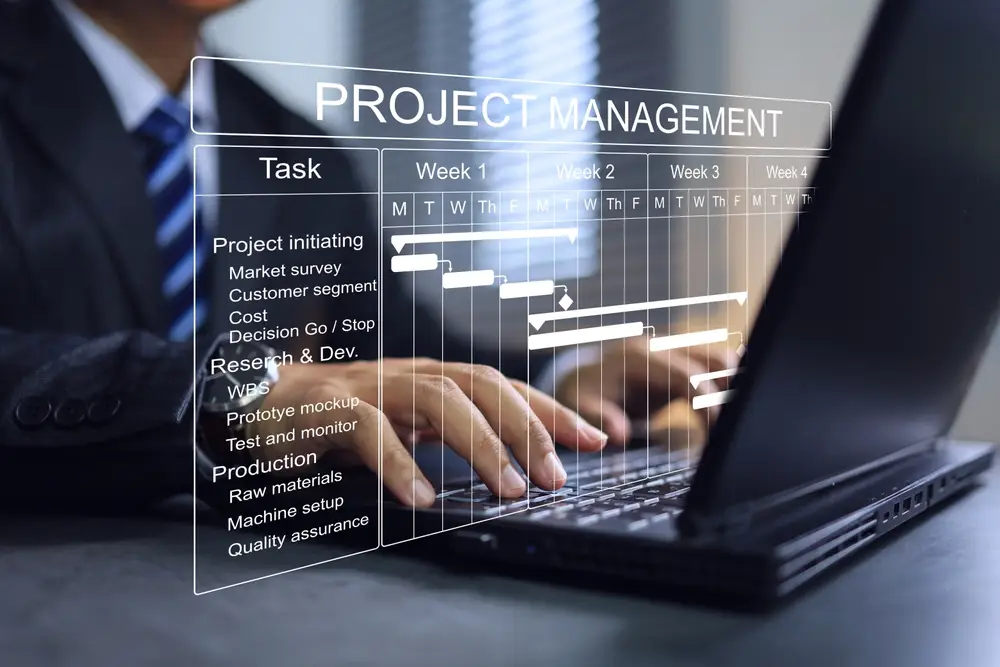
Use project management tools to create a single source of truth. Everyone should see the same task lists, timelines, and progress indicators. Conflicting information from different sources breeds confusion and mistrust.
Studies show that projects with proper tracking mechanisms have success rates 16 percentage points higher than those without. Make your progress visible through dashboards that show milestone completion, budget usage, and schedule status at a glance.
How Should You Approach Quality Assurance in Fixed Cost Projects?
Quality isn't something you add at the end, it's built in from the start. In fixed cost projects, poor quality becomes exponentially expensive because fixing defects after delivery often falls outside the agreed scope.
- Start testing the moment developers write code. Automated tests that run continuously catch bugs immediately rather than letting them pile up.
- Unit tests verify individual components work correctly. Integration tests ensure different parts work together smoothly.i
- Set quality standards that must be met before moving forward. These might include code coverage percentages, performance benchmarks, security scan results, and accessibility compliance. Don't rush ahead until current work meets your quality bar.
How Do You Handle Scope Changes Without Destroying Your Budget?
Despite your best planning, change requests will come. Markets shift, regulations evolve, stakeholders gain new insights. The question isn't whether change will happen, but how you'll manage it without destroying your budget.
Establish a formal change control process before starting work. Define how requests are submitted, who evaluates them, what criteria determine approval, and how impacts are assessed. This structure prevents casual "quick additions" that accumulate into major scope creep.
For every change request, assess the complete impact. Don't just consider the coding effort—evaluate effects on testing, documentation, training, integration, and future maintenance. Hidden costs often exceed obvious ones.
Keep a log of all change requests, their status, and outcomes. This transparency shows stakeholders the cumulative effect of changes and helps them make informed prioritization decisions.
When stakeholders want new features within the fixed budget, practice scope trading. What existing feature will you defer or remove to accommodate the new one? This forced prioritization keeps scope contained while maintaining flexibility.
Remember, not every good idea belongs in the current project. Save major enhancements for phase two. This validates stakeholder input while protecting current delivery commitments.
Final Thoughts
Delivering fixed cost software projects successfully isn't about luck—it's about discipline. When you combine thorough planning, proactive risk management, clear communication, and continuous quality focus, software development transforms from an unpredictable gamble into a reliable business process.
Why Choose CodeSuite for Fixed Cost Software Development Services
At CodeSuite, we've mastered the art of fixed cost software delivery. Our proven methodology combines thorough upfront planning with agile development practices, giving you complete budget certainty without sacrificing quality or flexibility. We understand that your software investment represents business goals, customer satisfaction, and competitive advantage—not just code.
Reach out to us for a comprehensive project assessment where we'll discuss your specific requirements, timeline constraints, and budget expectations. Our team will provide an honest evaluation of your project and outline exactly how we'll deliver success.
Contact CodeSuite today for fixed cost software development services that combine technical excellence with business partnership—delivering the solutions you need, when you need them, at the price you agreed.
Do you need a pricing model that actually works for you? Check out CodeSuite’s fixed price solutions for clarity and control.
Frequently Asked Questions
Q: What types of projects work best with fixed cost software development?
A: Fixed cost models are ideal for projects with well-defined requirements and clear deliverables. This includes system migrations, product launches with specific feature sets, regulatory compliance implementations, internal business tools, and customer portals.
Q: How do you handle unexpected technical problems in a fixed cost project?
A: Professional fixed cost agreements include contingency buffers and risk management processes specifically for unexpected challenges. During the discovery phase, teams identify potential technical risks and plan mitigation strategies.
Q: Can you use agile development methods in fixed cost projects?
A: Absolutely. Many modern fixed cost projects use "agile with fixed scope"—applying agile practices like sprints, daily standups, and iterative development while maintaining a predetermined feature set and budget.