
Beyond the hype: Why agentic AI is closer than you think
Oct. 22, 2025
851

Table of Contents
In recent years we’ve watched the rise of generative AI and large-language models (LLMs) that can write, translate, summarize, and even compose code. But now a new term is attracting attention: agentic AI. This isn’t just a sleeker chatbot. It’s AI that plans, acts, adapts, and collaborates automatically.
While some cheer it as the next tech frontier and others dismiss it as hype, the truth is this shift is already under way, and it’s much closer than we often assume. Let us dig deeper into it...
Key Takeaways
|
Key Takeaways |
|
Agentic AI doesn’t just answer, it plans, acts, and learns. It works toward goals instead of just replying to prompts. |
|
Generative AI: “Write an essay.”Agentic AI: “Reach a goal, take steps, and adjust as needed.” |
|
The move from chatbots to goal-driven agents is already happening. Businesses are demanding AI that can act, not just talk. |
|
AI systems will plan and execute steps to achieve targets, using tools and memory to improve over time. |
|
Multiple specialized AIs will work together (e.g., research agent + analytics agent) to complete tasks. |
|
Agentic AI = shift from “AI helps” to “AI acts.” It’s already arriving, the challenge is to steer it with human values and control. |
What is Agentic AI?
At its core, agentic AI refers to systems that go beyond reactive responses. Instead of waiting for a prompt and returning an answer, agentic AI perceives its environment, reasons about objectives, acts toward goals (often via external tools), and learns from outcomes.
In simpler terms:
- Generative AI (LLMs) = “Here’s a topic; write an essay”
- Agentic AI = “Here’s a goal; figure out how to achieve it, coordinate steps, take action, adjust as you go.”
It is a distinct shift from telling an AI what to do, to handing it what outcome you want and letting it organise the how.
Another way to think of it: a typical chatbot answers a question, an agentic system sets a goal, breaks it into subtasks, uses tools, monitors progress, and adapts as needed.
This evolution matters because it moves AI from being a passive assistant to being an acting partner.
Why It’s Closer Than You Think?
The narrative often is: “Agentic AI is years away.” But in fact, multiple indicators suggest the transition is well under way. Let’s look at some of the signals:
The journey from rule-based automation → generative AI → agentic systems is already unfolding. As described by firms like Accenture, we are leaving behind “one-shot” models (you ask, it answers) and entering the era of single-agent systems (plans + tool use) and multi-agent systems (multiple specialised agents collaborating) which is essentially agentic AI.
Part of what slows big shifts is the lack of shared protocols. In agentic AI, though, we see the formation of “agent-to-agent communication standards”, “model context protocols”, orchestration frameworks and shared memory systems, but key infrastructure that allows agents to plug in, talk to tools, talk to each other, and scale.
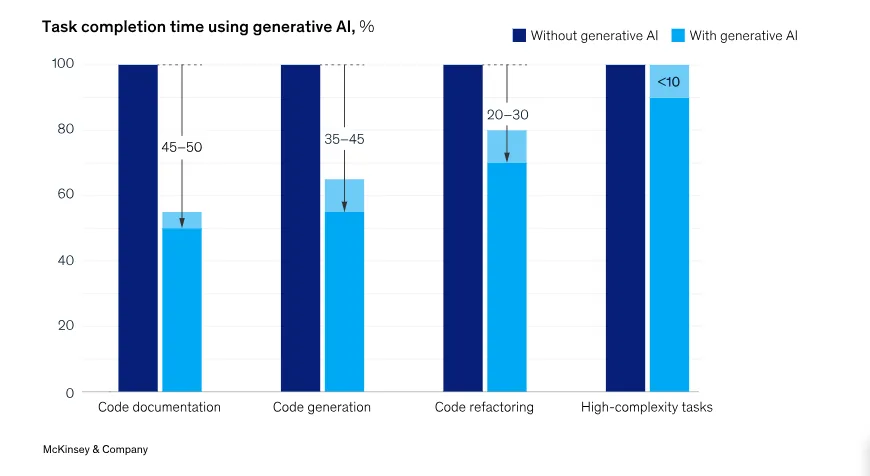 Why now? Because business pressure is mounting. Organisations want deeper productivity gains, intelligent workflows that span systems, and decision-making that goes beyond “what is the summary of X” to “what should we do, how do we implement it, and what happens next?” The pull of real-world value is forcing the transition sooner rather than later.
Read More about the Role of Artificial Intelligence in Digital Transformation
What Changes in Practice?
If agentic AI is accelerating, what will change for businesses, for workers, for systems? Below are several practical shifts.
Goal-oriented workflows
Today many AI systems wait for prompts. Agentic systems ask, “What are we trying to achieve?” and then orchestrate steps: analysis, tool invocation, coordination, feedback. Internally, you’ll see features like memory (so the agent recalls context over sessions), meta-reflection (it reviews what it did and improves), orchestration (splitting a problem into subtasks), and external tool usage (search, APIs, calendars, physical devices).
Multi-agent ecosystems
Rather than one monolithic agent, systems may comprise multiple specialised agents (research agent, analytics agent, validation agent) working together to deliver outcome.The implication: you no longer build one big model, you build an ecosystem of agents with coordination and communication between them.
Shifting human role
Humans will increasingly move from micro-management (“tell me what to output”) to macro-management (“set the goals, monitor the results”). The human becomes supervisor of the agentic system rather than its operator. That shifts skills: goal formulation, evaluation, ethical oversight, strategy rather than execution.
Decision-making and Action
Whereas earlier AI might suggest what to do, now agentic systems are able to do (click, order, route, schedule, change system state) with oversight. That makes the AI’s agency real: it’s not just advising, it’s acting. This amplifies value, but also risk.
What the hype gets right?
- The shift from reactive to proactive intelligence is real and game-changing.
- The component technologies (LLMs, tool integration, memory systems, orchestration) are advancing quickly.
- Early ROI stories are emerging, careful pilots are already discovering value.
In short: agentic AI is closer than many think, but it is not magic, nor is it without obstacles.
Read more about AI-Driven Digital Transformation Strategies & Trends 2025
Real-World Implementation
For organisations
- If you wait until “everything is ready”, you’ll be playing catch-up. Organisations that experiment early with agentic workflows will have a competitive advantage.
- To benefit, you need clean data, tool access, orchestration layers, well-defined goals, and clear governance. Being unprepared means you risk costly failures.
- As agentic systems act rather than just suggest, you need new frameworks around auditability, decision-traceability, bias mitigation, and liability.
- The human workforce will need to adapt, from executing tasks to supervising agents, setting goals, reviewing performance, and managing exceptions.
For workers
- Many routine tasks may be handled by agentic systems; humans will shift toward higher-level, creative, supervisory, strategic functions.
- Skills such as goal articulation, oversight of AI systems, understanding AI-decision making, violation detection, exceptions handling become more important.
- Rather than simply using AI, you’ll work with agentic systems, designing them, directing them, refining their behaviour, ensuring they align with human values.
If you’re an executive/organisational leader:
- Identify strategic workflows that are currently high-value and complex, and assess how agentic systems might transform them.
- Invest not only in models, but in the infrastructure: data pipelines, tool integrations, orchestration layers, memory systems.
- Begin small: pilot agents in narrow domains, evaluate, refine, then scale.
- Build governance frameworks now: define accountability, audit trails, ethical guardrails, KPIs for agents.
- Prepare the workforce: define new roles, provide training, clarify how humans and agents will interact.
If you’re a worker or professional:
- Cultivate skills of supervision, evaluation and goal-setting rather than just execution.
- Understand AI’s strengths and limitations: know what agents can do, what they can’t, where human oversight remains vital.
- Be curious: experiment with AI agent tools in your workflow, understand how they think, plan, act.
- Maintain a “trust but verify” mindset: even if agents act on your behalf, humans must check and guide them.
If you’re a developer or technologist:
- Familiarise yourself with architectures for multi-agent systems, orchestration frameworks, memory systems and tool integration.
- Think deeply about safety, interpretability, auditability and ethical alignment: design agents that are transparent, controllable and align with human intent.
- Focus on incremental deployment: start with well-defined goals, specialised agents, clear monitoring; avoid building “everything” from day one.
- Monitor evolving standards and protocols: as agentic AI matures, frameworks for agent-to-agent communication, tool access, memory, security will become important.
Conclusion
To understand agentic AI is to recognise the shift: from AI as helper → AI as executor. It is a transformation in how we think about AI’s role.
So the question isn’t will agentic AI arrive, it’s how we use it, when we integrate it, and how well we steer its emergence so that human values, human oversight and human purpose remain central. The era of agents is not just near, it is arriving.
Our experts at CodeSuite are eager to help you create a plan that fits your goals, budget, and compliance requirements. Think of it as an investment in your business’s long-term health and growth.
Drop us a message today or give us a call, and we’ll start planning your roadmap to reduced costs and better productivity.
Don’t wait, your competitors might already be taking the leap!
Why let another month of hidden costs slip by? Let’s talk!